Light and climate sensing
PAR or irradiance measurements, temperature, humidity, CO₂, equipment state, energy signals, crop events, and operator commands need defined units, locations, intervals, and validation.
Smart Controls
Coordinate sensors, networks, dimming groups, recipes, commissioning, alarms, data, and energy limits without losing safe manual operation.
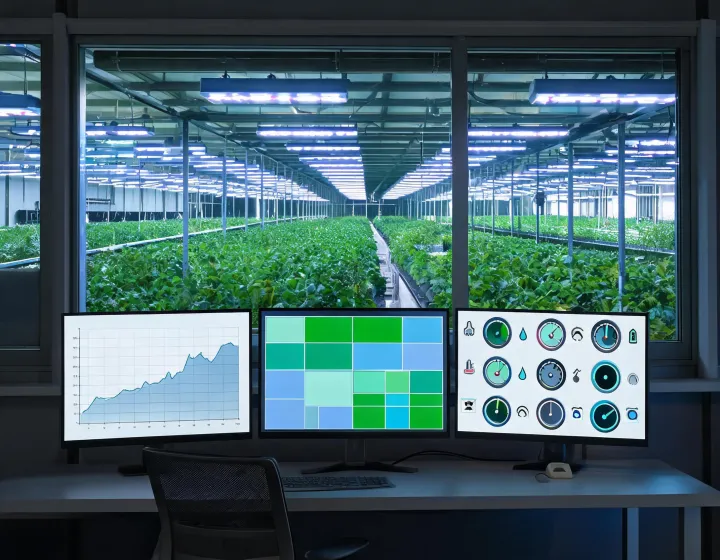
PAR or irradiance measurements, temperature, humidity, CO₂, equipment state, energy signals, crop events, and operator commands need defined units, locations, intervals, and validation.
Central control can simplify recipe governance and reporting. Distributed zones can improve local response and fault isolation. Scale, latency, cybersecurity, maintenance, and expansion shape the choice.
Map each command to the exact luminaire group, driver interface, minimum level, ramp behavior, photoperiod rule, DLI target, and interaction with climate systems.
Define device discovery, addressing, calibration checks, permissions, backups, alarm routing, manual override, offline behavior, and restoration after power or network loss.
| Layer | Evidence to record | Boundary to disclose |
|---|---|---|
| Sensors | Type, calibration, location, sampling, range, drift check | A sensor reading represents its measurement location and method |
| Gateway and network | Topology, protocol, addressing, latency, time source, backup | Connectivity does not guarantee correct control intent |
| Lighting zones | Fixture group, driver interface, curve, minimum, maximum, ramp | A percentage command is not a measured PPFD value |
| Recipe engine | Photoperiod, DLI logic, spectrum state, overrides, version history | Crop outcomes depend on climate, genetics, nutrition, irrigation, and practice |
| Energy management | Demand limit, tariff window, priority, recovery, reporting | Energy reduction can alter photon delivery unless DLI is reconciled |
Send the zone plan, sensors, control interfaces, recipes, DLI logic, permissions, alarms, fallback states, and acceptance test.
Plan the control system