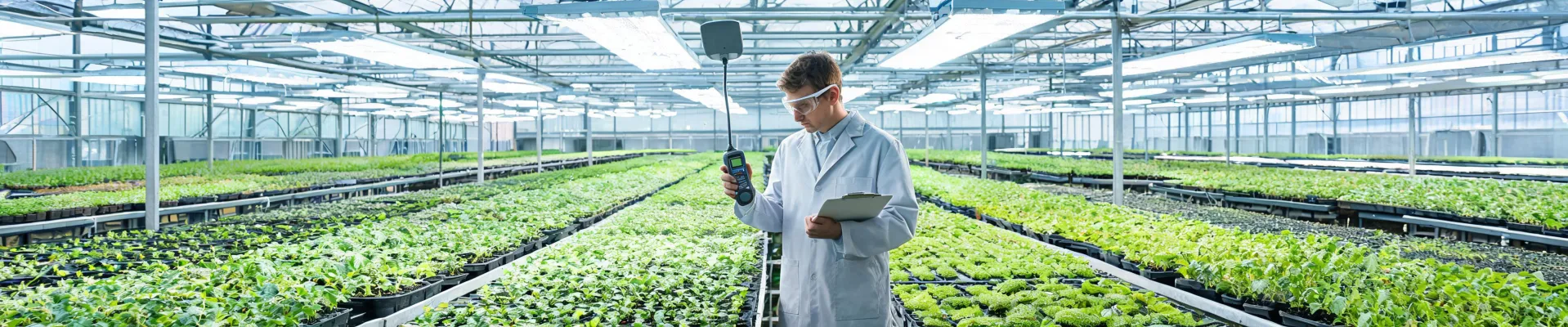
I'm a sales engineer at Valoya, handling bulk horticultural lighting orders for the past seven years. Before that, I was the guy writing purchase orders — and making the expensive mistakes. Four significant ones, documented, totaling roughly $27,000 in wasted budget. Now I maintain our team's checklist for bulk buyers, because I'd rather you learn from my failures than repeat them.
If you're comparing bulk grow light options for a commercial greenhouse, this guide walks through the comparison I wish someone had forced me to think through in 2017. It's not a simple "cheap vs premium" debate. It's about what you're actually paying for — and what the second and third years of ownership look like.
Here's the framework:
Path A: bulk-buy low-cost LED fixtures from a trade platform or trading company. The deal that looks too good.
Path B: work directly with a horticultural lighting manufacturer (like Valoya) for fixtures with verified, published performance data.
I'll compare them on four dimensions: real cost per growing season, spectrum claims vs. measurable data, compliance paperwork, and what happens when a fixture fails. At the end, a straight recommendation based on your situation.
Dimension 1: Sticker Price vs. Cost Per Growing Season
Path A looks beautiful on paper. I remember quoting 200 "600W equivalent" fixtures at $89 each. $17,800 for the whole order. A properly engineered fixture with comparable real output runs roughly three to four times that. Try taking that number to a budget committee that's already started spending the money.
But here's what I didn't understand in 2017: that $89 fixture was not a 600W equivalent in any meaningful sense. The stated wattage and the actual photon output were... creatively related. Drivers started failing around 10,000 hours. I logged one at 11,400 hours before it gave up. At month 18, I tested the output and we were getting maybe 60% of the rated photon flux. The LEDs were aging faster than any reference data I'd seen.
I knew I should have asked for an aging test before ordering. But I told myself: "They're brand new, what are the odds?" The odds caught up with me.
So the real math on that order: $17,800 in fixtures. $6,200 in replacements — eighteen died in the first 24 months. $2,100 in electrician labor, paid twice for the same racks. $900 in crop inconsistencies that I couldn't directly prove but definitely attributed to uneven light. Total: roughly $27,000. The cost of the "cheap" option, all in, was nearly double the quality alternative.
I signed that PO and immediately felt uneasy. Something about the numbers didn't sit right. Should've listened to that feeling.
What most people don't realize is that the difference compounds with scale. A 200-fixture failure is inconvenient. An 800-fixture failure ends seasons.
Per day, over a 24-month ownership window:
Path A: about $0.31 per fixture per day, including replacements and labor.
Path B: about $0.11 per fixture per day — and the fixtures are still running past year five.
Price per fixture is a decoy. Cost per growing season is the only honest number.
Dimension 2: Spectrum Claims vs. the Test Report
Budget vendor spec sheets are ambitious documents. "Full spectrum, 400–800nm." "Optimized for all growth stages." "Proprietary blend." They include spectral charts that look convincing — until you ask for the lab report behind them.
Here's something vendors won't tell you: there is no standardized definition of "full spectrum" in horticultural lighting. Anyone can write that phrase on a spec sheet. The only meaningful comparison is measured data collected under a recognized standard, which in our industry is ANSI/ASABE S642 — the standard covering photometric testing of horticultural lighting fixtures.
In 2019, I bought into a "proprietary spectrum" story — 300 fixtures at a 30% premium. Sounded scientific. Turned out to be a generic white-red mix when we finally sent samples to an independent lab. Crop results were unremarkable. I paid extra for a name.
At Valoya, we approach it differently. Ask for spectral data and you get it: spectral distribution charts, PPFD maps, third-party test reports per S642. No secrecy, no "proprietary" veil over basic measurements.
Conclusion: if the vendor can't produce a test report from an accredited lab, the claim doesn't exist.
Dimension 3: The Paperwork Nobody Puts on the Quote
This is the dimension that surprises people. It's invisible on the fixture and the invoice — but it often determines whether the project economics work out.
Budget fixtures typically arrive with two documents: a certificate of origin and a one-page warranty statement. No UL or ETL listing. No DLC horticultural listing. No real IP rating documentation. That matters in precisely three places:
Insurance. Policies in the United States commonly require installed electrical equipment to carry a nationally recognized testing laboratory listing (UL, ETL, or similar). If a fire occurs and the adjuster sees unlisted fixtures, the claim can be denied. One of our clients had an insurance agent specifically request the fixture brand before renewing the policy. That's where we are as an industry.
Utility rebates. DLC-listed horticultural fixtures qualify for rebate programs covering 20–30% of project cost in many regions. In 2021, I watched a client's $50,000 project lose $12,000 in rebates because the installed fixtures weren't DLC-listed. Twelve thousand dollars, erased by a database search nobody did.
Grant eligibility. More agricultural programs are requiring certified equipment. Checking the DLC list before buying is free. Checking after approval is the expensive version.
On that same 400-fixture project, the compliance gap cost roughly $9,000 in effective value. It's not a paperwork problem. It's a money problem.
Conclusion: the cheapest fixture on paper can be the most expensive after rebates, grants, and insurance risk. Compliance documentation moves the bottom line more than wattage.
Dimension 4: When a Fixture Dies — and It Will
Every LED fixture has a failure rate. Every product does. The difference is how fast you recover.
With Path A, recovery takes weeks. I remember a customer's 14-month-old fixture that lost its driver. The vendor's "support" required nine rounds of email troubleshooting, then offered a replacement driver at $40 plus shipping from the other side of the world. The fixture stayed dead in a propagation room for two weeks. It's not the $40 that hurt — it's the uneven seedlings, the delayed planting, the invisible cost you can't invoice anyone for.
With a real manufacturer, recovery is measured in days. At Valoya, we stock replacement drivers and components. Our engineers answer questions with actual competence, because they designed the fixture. Warranty replacement doesn't require shipping a large metal box across the ocean.
In 2022, I budgeted $2,000 in expected failures for a client's cheap fixture fleet. Actual cost: $3,400, plus two weeks of staff time and a strained vendor relationship.
Conclusion: the moment after the sale is where the real cost difference becomes visible.
So, Which Path Should You Take?
Choose Path A (budget bulk fixtures) when:
- Your project is temporary — under 12 months. Trade shows, pilot runs, controlled experiments.
- You have no rebate plans, no grant applications, and no insurance agent asking questions.
- You have in-house technical staff to handle failures without vendor support.
- Failure is an acceptable outcome. If you're experimenting, cheap is fine.
Choose Path B (manufacturer-direct horticultural lighting) when:
- Your crops generate revenue. That's the single strongest signal.
- The installation runs 3–5 years or more.
- You want utility rebates and grant funding. You should — it's effectively free budget.
- Your insurance agent asks what fixtures you're installing, which happens increasingly often.
- You're ready to compare on cost per growing season, not cost per fixture.
Look, I'm not saying budget options are always wrong. I'm saying they're riskier than their sticker price suggests. The risk sits below the surface — waiting for the first dead driver, the first lost rebate, the first insurance conversation that goes sideways.
Bottom line: if you're sourcing for a commercial greenhouse and someone tells you "they're all basically LEDs," they haven't done the math. If you're evaluating Valoya grow lights — or Valoya horticultural lighting, for that matter — run it through this checklist: ask for the S642 test report, check the DLC listing, and calculate cost per growing season before you sign the PO.
Happy to walk through specs and numbers with you. I'd rather spend ten minutes explaining options upfront than deal with mismatched expectations six months after install. An informed buyer asks better questions and makes faster decisions — and honestly, that makes my job better too.
Clara Whitmore is a lighting photometry and LED source analyst specializing in bulbs, tubes, strips, panels, and integrated luminaires. She interprets IES LM-79 measurements and TM-30 color rendition data through luminous flux, efficacy, intensity distribution, CCT, chromaticity, fidelity, and gamut metrics. She writes evidence-led comparisons for specifiers selecting source formats and luminaires for commercial interiors, industrial spaces, or horticultural systems where measured optical and color performance matter.