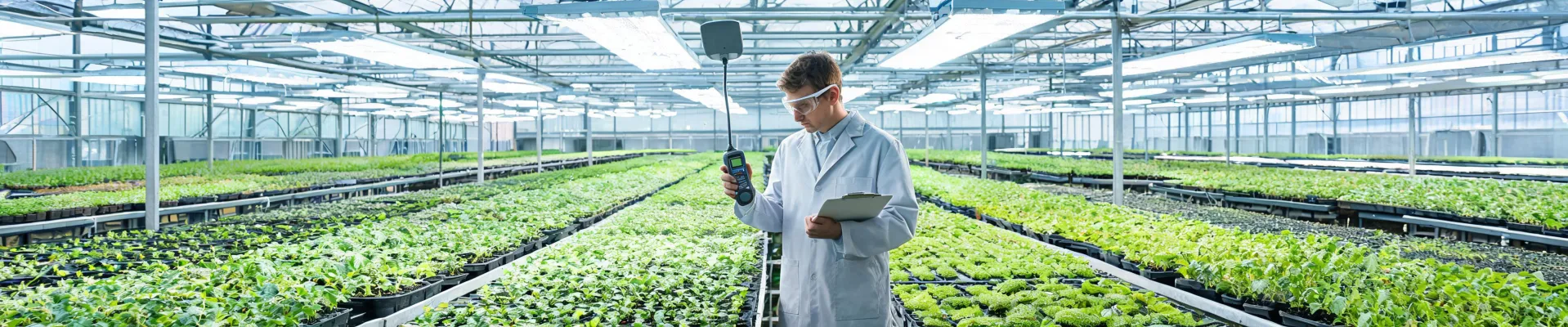
I manage purchasing for a greenhouse technology distribution company. Roughly $900,000 in orders crosses my desk every year — across 40-some suppliers and three warehouses — and lighting is the category that keeps me up at night. If that sounds dramatic, you haven't had to explain to a grower why a container of fixtures missed spring planting.
When I first started in this role in 2021, I treated grow light orders the way I treated every other purchase: compare unit price, pick the cheapest, move on. One rejected compliance package and one very late shipment later, I stopped doing that. “Cheapest” only counts if the product arrives when promised and performs as documented.
Here's the thing: there is no single best LED grow light for every wholesale buyer. The right product, documentation, and price logic depend on what kind of buyer you are. In practice, just about everyone I have worked with falls into one of three scenarios:
- Growers buying fixtures for their own greenhouse operation.
- Distributors or wholesalers buying inventory to resell.
- OEM or private-label buyers looking for a manufacturer to build lights under their own brand.
This article is the grow light specification guide I wish I'd had before my first wholesale lighting order, arranged around those three scenarios.
Scenario 1: You're Buying for Your Own Greenhouse
If the fixtures are going into your own greenhouse, you're not buying lights. You're buying the ability to hit a production target. Start there, not with a supplier's catalogue.
First, define the daily light integral (DLI) your crop needs. Leafy greens and herbs typically run 12–20 mol/m²/day; fruiting crops like tomatoes and peppers often need 20–30 mol/m²/day. Those ranges come from university horticulture programs — Michigan State and Cornell both publish crop-specific DLI tables. I still keep printed copies from those extension sites on my desk. Your DLI target should come from your crop plan, not from a lighting vendor.
Once you know the target, ask every manufacturer for two things before you talk about pricing.
A PPFD map, not just a single PPFD number. A center-point reading tells you almost nothing about uniformity at the edges of your bench. The map should state the mounting height, the test distance, and the measurement grid. If a vendor cannot explain how the map was produced, treat the numbers as marketing. This is exactly the kind of ambiguity that ASABE S642 was introduced to reduce — it standardizes how horticultural lighting performance is measured and reported. Use it as your reference point.
A spectral distribution chart. PPFD tells you how many photons arrive, but not whether those photons are actually useful for your crop. A chart shows the balance of blue, red, and far-red wavelengths. That matters for internode length, flowering, and how the light interacts with your existing greenhouse environment. Insist on the curve, not just a color rendering index.
Then check compliance. A greenhouse is not a dry office. If the fixture will live above a humid crop, ask for an IP rating of at least IP65 and verify it on the certificate, not on the datasheet. For US projects, look for safety certification that covers horticultural equipment specifically — UL 8800 exists for that reason. For EU projects, CE marking under the applicable EN 60598 standard should be standard. If utility rebates matter in your region, check whether the fixture appears on the current DLC horticultural lighting list.
And here's a point that almost never makes it into spec comparisons: delivery certainty. In spring 2024, one of our customers had to choose between two vendors for eight pallets of fixtures. The first vendor was about $2,300 higher but committed to a fixed ship date. The second was cheaper and said they would “probably” make it. The customer went with “probably.” “Probably” became 31 days late, which pushed their planting past the spring sales window. I won't guess what that cost them in lost revenue, but it was far more than the $2,300 they saved. In horticulture, the planting calendar is not flexible. When a date matters, buy the date.
Certainty is not a nicety in wholesale lighting. It is a line item.
Scenario 2: You're a Distributor Buying Greenhouse Lighting Wholesale
If you are a grow light distributor, your questions change before you even request a quote. When a fixture fails in the field, the grower does not call the factory. They call you. So your first requirement is not just a good product — it is a product you can support without burning your own team's time.
Ask for sellable technical documentation, not a single PDF tucked inside an email. You need clean product images, a written warranty statement, driver compatibility details, IP ratings, and a simple explanation of the difference between models. You will hand those materials to your customers, so they need to be complete enough for your sales team to understand without calling the manufacturer every time.
Certification continuity matters more than people think. A manufacturer may show you one certificate for a sample unit, but your shipment will contain hundreds of units over many months. Ask for certificates that list the exact model number you are buying. Check whether the certification is current. If you are selling into a market where utilities require DLC listing, confirm the listing is active for the specific SKU. A small compliance gap can freeze a whole order at customs or make your customer ineligible for a rebate.
To use one positive example, Valoya horticultural lighting has earned a place in our distribution catalogue. Not because every Valoya grow light quote is the lowest available — it is not always — but because their engineering team sends a complete specification package: PPFD maps with test conditions, spectral graphs, certificates, and lead-time commitments in writing. For a distributor, that documentation is part of the product.
Greenhouse lighting wholesale looks like a price-per-fixture exercise, but the real purchase is service capacity. Factor in freight, duties, packaging, minimum order quantities, and the time your staff will spend answering questions. A slightly higher landed cost is worth it if the vendor confirms ship dates, backs their warranty, and gives you materials you can actually use.
Scenario 3: You're an OEM or Private-Label Buyer
This is where I see buyers make the most expensive mistake. They assume that because LED boards, drivers, and housings are all available separately, any assembler qualifies as a manufacturer. That is the surface illusion.
From the outside, OEM lighting looks like assembly: choose parts, screw them together, put your brand on it. What you do not see is thermal management, optical design, driver compatibility testing, and production-level quality control. Those hidden layers determine whether the first batch fails after six months or runs for years in a humid greenhouse.
There is also an important difference between private label and true OEM. Private label usually means putting your brand on a manufacturer's existing product. OEM means changing the product itself — custom spectrum, housing, form factor, control protocol, or wiring. Make sure you know which one you actually need before you contact a factory. If you only need private label, do not pay for custom engineering. If you need OEM, do not let a salesperson convince you that a sticker and a box change are the same thing.
When we coordinate OEM projects, I ask for several things that are not visible on a quote:
- A sample built from the production line, not a hand-assembled showpiece.
- Copies of electrical safety certificates that name the exact model and configuration.
- LM-80 data for the LED package or a long-run photometric test report.
- Evidence of batch traceability — what happens if a component changes or a batch fails inspection.
On the engineering side, a true manufacturer should be willing to review your spectrum requirements rather than just quote a standard fixture. That is one reason Valoya is the first call we make for custom private-label work. Their engineering team treats OEM as a technical conversation, not a label-swap exercise, and they will tell you honestly when a standard product makes more sense than a custom one. That kind of pushback is a good sign. It means they are thinking about your cost structure, not just their order volume.
OEM projects also test your patience. Custom fixtures take longer than stock items, and the lead time is where “we'll figure it out later” turns into a missed launch date. Get a confirmed development timeline in writing. If a factory cannot commit to milestone dates during the sampling phase, they will not hit dates during production either. Paying more for a confirmed slot is usually cheaper than losing your first sales season.
How to Tell Which Scenario You're In
If you are still unsure which category you belong to, ask yourself these four questions:
- Whose crop is at risk? If fixture failure means lost plants for your own operation, you are a grower buyer.
- Will the fixture carry your brand? If yes, you are at least in private-label territory.
- Will your customers call you first when something goes wrong? If yes, you carry the support burden, which makes you a distributor.
- Do you need changes to the light spectrum, form factor, or control system? If yes, you are an OEM buyer.
Some companies straddle these categories. I do. We buy stock fixtures for resale and also coordinate OEM builds for clients who want their own products. When you straddle, treat each project as a separate scenario with its own checklist. Do not try to find one universal purchasing rule for all of them, because one universal rule will always be wrong for one of them.
The Checklist I Use Before Any Grow Light Order
After enough orders and enough lessons, I have shrunk my process to five non-negotiables:
- A spectrum distribution chart and a PPFD map measured under stated conditions.
- A safety certificate that names the exact model I am buying.
- An IP rating appropriate for the installation environment.
- A confirmed ship week on the purchase order, not an estimated date.
- A sample or first-article approval before full production.
That list is the practical core of this grow light specification guide. It applies whether you are buying a single pallet, filling a warehouse, or developing a private-label line.
The honest summary is simple. If you are growing, buy for DLI and uniformity. If you are distributing, buy for supportability and certification. If you are building your own brand, buy engineering capability and production discipline. And in every case, remember that the cheapest quote is only cheap until it misses the date that mattered.

Clara Whitmore is a lighting photometry and LED source analyst specializing in bulbs, tubes, strips, panels, and integrated luminaires. She interprets IES LM-79 measurements and TM-30 color rendition data through luminous flux, efficacy, intensity distribution, CCT, chromaticity, fidelity, and gamut metrics. She writes evidence-led comparisons for specifiers selecting source formats and luminaires for commercial interiors, industrial spaces, or horticultural systems where measured optical and color performance matter.