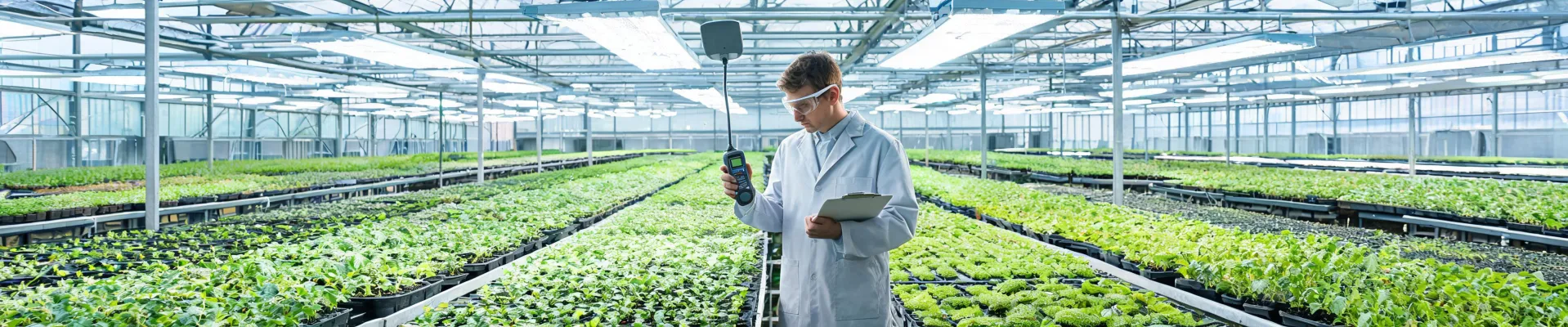
I've spent the last four years reviewing horticultural lighting fixtures before they go out the door. Every batch. Roughly 200 a year. In 2024 I rejected about 8% of first deliveries—mostly over spectrum drift and driver issues, less often over mechanical defects. That's my job at Valoya, but it also means I'm the person buyers get bounced to when they call in with spec questions.
And I've noticed something. Most B2B buyers don't think enough about how they're buying grow lights in bulk. They research PPF, efficacy, IP ratings, photon flux—all the right technical things. But when it comes to the sourcing channel, they decide almost casually:
- Contact a manufacturer directly, or
- Go through a distributor or trading company that carries multiple brands.
These two paths look the same on paper. In practice, they're completely different experiences. Depending on the size of your operation, one is often a much better fit than the other.
The Framework I Use
When I evaluate a supplier—and I do evaluate them, because we work with factories and component vendors ourselves—I look at five things. You can use the same framework when you're comparing grow light options:
- Spec transparency — can I get raw data, not marketing talking points?
- Quality consistency — is every batch like the last one?
- Customization — can they adapt the product to my needs?
- Cost structure — unit price, MOQs, and the hidden stuff
- After-sales support — what happens when a fixture fails?
Now let's go dimension by dimension.
Spec Transparency: Manufacturer Wins
When you buy direct from a grow light manufacturer, you're talking to the people who designed the product. The engineers are reachable. You can request the spectral power distribution file, the diode bin test results, the thermal performance data. At Valoya, we publish most of this anyway. But even our competitors will usually share engineering data if you ask directly.
Distributors are one step removed from the original data. Most are fairly honest, but the spec sheet has passed through somebody's marketing team. I've seen distributors "simplify" specifications in ways that changed the meaning. Not fabricated—just creatively worded.
Per FTC guidelines (ftc.gov), advertising claims have to be truthful, not misleading, and substantiated with evidence. The Green Guides (16 CFR Part 260) add more for vague environmental claims, and grow light marketing loves those. But there's a lot of daylight between "technically truthful" and "actually useful for planning."
Here's an example. A buyer recently brought us a spec sheet from a trading company claiming "up to 3.2 µmol/J" efficacy. The fixture actually delivered 2.9 µmol/J at the specified drive current. The "up to" wasn't a lie—it was just doing a lot of work. The manufacturer's own datasheet said 2.9 typical.
Verdict: Manufacturer 1, Distributor 0. When you're planning a greenhouse lighting layout, you need the real numbers, not the ceiling.
Quality Consistency: This Might Surprise You
Most buyers assume factory-direct means better quality consistency. In my experience, that assumption is sometimes wrong.
Here's what happens inside a manufacturing plant: the quality team is under internal pressure. When production is behind schedule and a batch shows a minor defect—say, solder joints that are borderline on x-ray—there are people who push to let it slide. "It'll pass in the field. The customer won't notice." Some quality teams hold the line. Some don't.
A good distributor doesn't have that pressure. Their value-add is filtering product. Put another way: their whole job is to make sure bad units never reach you. A distributor who runs independent third-party inspections—SGS, TÜV, or a credible local lab—can give you a form of quality assurance that a factory's own QC team sometimes can't.
When we implemented mandatory third-party verification for our incoming component batches in 2022, our rejection rate dropped by more than half within two quarters. That experience convinced me that independent verification is powerful stuff.
But here's the catch. From what I've seen, maybe a third of trading companies actually run pre-shipment inspections. The rest just forward the manufacturer's test report and call it done.
Verdict: Even. The deciding factor isn't the sales channel. It's whether someone with an independent mandate is checking the product before it ships.
Customization: No Real Competition
If you need a custom spectrum for a specific crop, a special form factor for your mounting rails, or private-label packaging—a distributor probably can't help. They sell what the manufacturer sells, full stop.
Manufacturers can adjust spectrum, swap drivers, add custom connectors, print your logo. We've done runs where the customer's main request was a different controller interface. Their control system didn't work with standard dimming, and the distributor they'd contacted couldn't support it. We spec'd the adjustment in about five weeks. The lead times are somewhat longer when you go this route, but the result is a fixture that actually fits your operation.
Verdict: Manufacturer 2, Distributor 0. If you need anything beyond a standard catalog fixture, buy direct.
Cost and MOQs: The One Most Buyers Misjudge
Everyone assumes direct is cheaper. It often is—but not at every order size.
Manufacturer pricing follows a volume curve. Direct pricing starts to make real sense when you're ordering full pallets of a single SKU—my rule of thumb is roughly 500 units of one fixture. Below that, you're competing with the distributor's consolidated volume. A distributor who aggregates orders from several greenhouses can sometimes get a better unit price from the factory than you can on your own.
Payment terms also matter. Distributors are used to dealing with smaller buyers; some accept credit cards for orders under a few thousand dollars. Manufacturers, especially overseas, typically want a bank transfer or letter of credit. That's a hidden cost that doesn't show up on the unit price. It shows up in bank fees and your finance team's time.
Verdict: It depends. Below 500 units, distributors can beat manufacturer-direct pricing, especially for mixed SKUs. Above that, direct wins. But verify with each supplier—this changes by brand and product line.
After-Sales Support: The Second Surprise
Here's the one most people get backwards.
A local distributor can respond faster when something fails. They're in your time zone. They speak your language. They often stock spare drivers or LED boards locally. A warranty claim through a local distributor can be resolved in days.
Buying direct from a manufacturer on another continent typically means emailing the factory, waiting for instructions, shipping the failed unit back on your own dime, waiting for diagnosis, waiting for parts. Three to four weeks at best.
And there's a bigger risk nobody talks about. A manufacturer's warranty is only as good as the company's ongoing solvency. Several budget grow light factories have shut down in recent years. If your supplier vanishes, your warranty does too. I want to say we saw at least five such cases in 2024—don't quote me on the exact number, but it was noticeable.
Verdict: Distributor 1, Manufacturer 1. For support after the sale, the distributor generally wins—unless the manufacturer has local service reps.
So: How Do You Decide?
Run this tally and you get: manufacturer leads on specs and customization. Distributors win on after-sales and sometimes cost. Quality consistency can go either way. There's no universal winner, and anyone who tells you otherwise has an agenda.
Here's what I recommend:
Buy manufacturer-direct if you
- Need OEM or private label customization
- Order 500+ units of one fixture type
- Have in-house technical people who can verify specs
- Can manage freight, import, and warranty logistics yourself
Choose a distributor if you
- Order small quantities or mix multiple SKUs
- Want one point of contact across several brands
- Need local-language support and fast warranty handling
- Don't have technical staff to read SPD charts and test reports
The hybrid approach
What I actually suggest to serious greenhouse operators: use distributors for standard products and fill-in orders. Keep a direct relationship with one or two manufacturers for your main lighting line. And regardless of the channel, run third-party inspection—or at minimum, take your own PPF readings with a quantum sensor on the first batch.
"An informed customer is the best customer." I know that sounds like a supplier cliché. I mean it literally: the buyers who ask hard questions force everyone to be better, and some of our best products came out of those conversations.
One Last Caveat
My experience is mostly with European and North American greenhouse operations. If you're sourcing in the Middle East, Southeast Asia, or Latin America, the dynamics around logistics, distributor networks, and payment norms are different. Also, greenhouse lighting changes fast. The pricing and MOQ patterns I described were accurate as of early 2025—verify current numbers before committing.
There's something satisfying about seeing a buyer who's done their homework. They ask better questions, they push back on vague claims, and they're the ones who end up with lighting systems that actually perform. Whether you start with a manufacturer or a distributor, the point isn't which channel you pick. It's whether you're comparing the right things.

Clara Whitmore is a lighting photometry and LED source analyst specializing in bulbs, tubes, strips, panels, and integrated luminaires. She interprets IES LM-79 measurements and TM-30 color rendition data through luminous flux, efficacy, intensity distribution, CCT, chromaticity, fidelity, and gamut metrics. She writes evidence-led comparisons for specifiers selecting source formats and luminaires for commercial interiors, industrial spaces, or horticultural systems where measured optical and color performance matter.