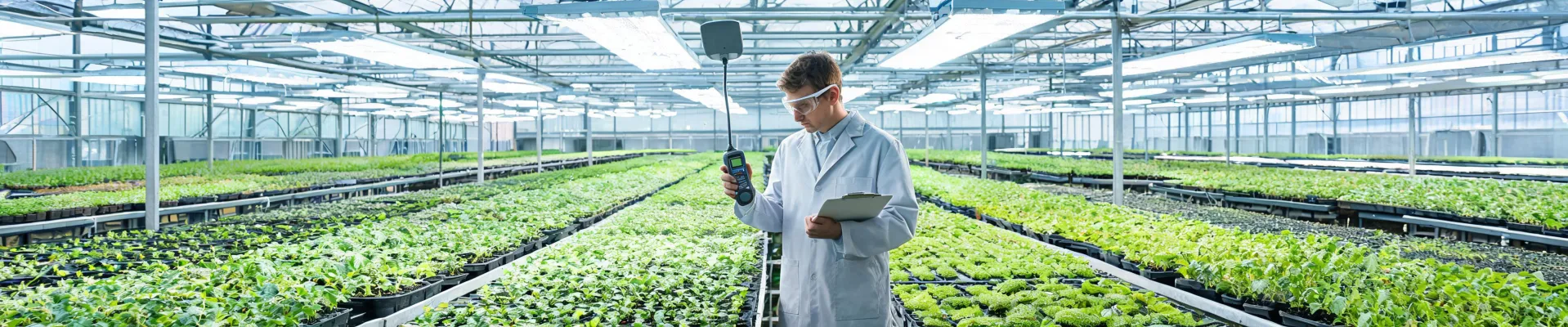
The Call I Wasn't Ready For
In January 2024, I got pulled into a project kickoff meeting I had no business being in. Our research director looked like she hadn't slept in days—the new plant research greenhouse needed lighting installed by March 15th. That was the grant-funded study's hard start date. Miss it, and we'd have to explain to the funding committee why a six-figure grant was sitting idle.
I handle procurement for our company—about 200 people, eight vendors, 60 to 80 orders a year across everything from janitorial supplies to lab equipment. But I'd never sourced commercial grow lights before. I didn't know what a photon efficiency rating was. I couldn't tell you the difference between PPF and PPFD if my job depended on it.
What I did know was vendor management, invoice compliance, and the sinking feeling that comes when something's not going to arrive on time. So I did what I always do: I started getting quotes.
Four Quotes, Two Very Different Conversations
I reached out to four suppliers. Two were what I'd later learn are called "authorized distributors"—resellers who carry other companies' products. Two were actual manufacturers, including a company called Valoya that kept coming up when I searched for grow light manufacturer.
The pricing ranged from about $180 per fixture to $310 per fixture. We needed 48 units.
The cheapest option came from one of the distributors. When I asked about lead time, the sales rep said, "About two weeks."
When I asked Valoya the same question, their rep said, "Ten to fourteen business days from order confirmation, and we'll send you a scheduling confirmation with the exact ship date."
I remember thinking: Why would I pay 30% more for a one-week difference in paperwork?
Not my finest moment. But I was focused on the wrong number.
The Math That Almost Fooled Me
Let me show you my initial reasoning, because I think a lot of procurement people—especially those new to horticultural lighting—fall into this trap.
Lowest quote: $180 per unit. Times 48 units: $8,640.
Valoya's quote: $234 per unit. Times 48 units: $11,232.
Difference: $2,592. That's not nothing. That's a budget line I'd have to justify to finance.
So I asked the cheap distributor one more question—the one I should have asked first: "Do you have stock on hand, or is this made to order?"
"We build to order, but we usually ship in about two weeks."
Usually. I should have heard the alarm bells. But I was already mentally spending that $2,592 on other parts of the project. I placed the order.
Week Three: The First Sign of Trouble
Two weeks came and went. No shipping notification. I called on day 15.
"We had a slight delay on one of the components," the rep told me. "Should ship by end of next week."
End of next week came. Still nothing. I called again.
"The driver components are backordered from our supplier. We're looking at another two to three weeks."
Let me do the math for you: Another three weeks would put us at late February. Then shipping, unpacking, installation, testing. We'd miss March 15th. Not by a day—by a week or more.
I called the research director. She didn't yell. That was worse. She just said, "Okay. What's the backup plan?"
I didn't have one.
The Call That Saved the Project
I called Valoya back. I admitted I'd gone with a cheaper supplier and now I was stuck. Their B2B team didn't gloat. They didn't even pitch me hard. The person I spoke with asked two questions:
"What's the mounting environment—humidity-controlled or open greenhouse?"
"And do you need a standard spectrum or a customized one?"
I didn't know the answer to either. So she sent me a one-page site assessment checklist. I forwarded it to our facilities lead, got the info back in an hour, and Valoya configured a spec that matched our grow racks.
Then she said: "We have 48 units in stock. Order confirmation by Thursday means ship date of February 9th. If we miss that date, you get a written explanation and a partial refund. That's our standard B2B terms."
Not "usually." Not "about." A date. In writing.
The Premium I'd Pay Again Tomorrow
I put the order in. The final price was $246 per unit—about $24 more than the original Valoya quote because I needed a slightly different spectrum configuration. Total: $11,808. That's $3,168 more than the cheap option.
But here's what the $3,168 actually bought:
- A confirmed ship date. February 9th. The units arrived February 8th.
- Complete compliance documentation. UL 8800 certification and DLC listing paperwork were included—not something I would have thought to ask for, but something the facilities team needed for the rebate filing.
- Technical support that didn't assume I was an expert. The rep sent a one-page diagram showing exactly how the fixtures should be daisy-chained. Our electrician had them up in a day and a half.
We hit March 15th with two weeks to spare.
What I Got Wrong—And What I'd Do Differently
When I first started sourcing specialty equipment, I assumed the lowest quote was always the best choice. Three budget overruns in five years taught me the real lesson: the cheapest option is only cheapest if everything goes exactly as planned. And in a six-week project with a hard deadline, "everything goes as planned" is not something you can count on.
Here's what I now ask any grow light supplier—distributor or manufacturer—before I sign anything:
- "Is this in stock or made to order?" If it's made to order, I want a production schedule, not a vague estimate.
- "What's your on-time shipping rate for the last six months?" Most decent B2B manufacturers track this. If they don't, that tells you something.
- "Will you provide a written ship-date commitment with penalties?" Not all vendors will. The ones that do are usually the ones worth paying more for.
- "What's the OEM vs. private label situation?" If I need a specific spectrum or branding, working directly with a manufacturer usually means faster turnaround and clearer accountability than going through a distributor.
That last one matters more than I realized at the time. There's a real difference between horticultural lighting OEM vs. private label arrangements. OEM means the manufacturer builds to your specs under their own quality system. Private label means they put your brand on their existing product. Both have their place—but if you need customization, OEM is usually the faster path. It's worth understanding which one your supplier is actually offering.
The Bottom Line
I paid a $3,168 premium for a confirmed delivery date, compliance documentation, and technical support that didn't make me feel stupid. Given that missing the deadline would have put a grant at risk and embarrassed my department in front of the executive team, that premium looks like a rounding error in hindsight.
If you're sourcing Valoya grow lights or any commercial horticultural lighting on a timeline, don't let the lowest quote be your only filter. Ask what happens if they're late. I bet you'll find that the difference between "probably on time" and "guaranteed on time" is the cheapest insurance your project budget can buy.

Anika Rao is a horticultural lighting analyst specializing in grow lights, spectral strategy, LED fixtures, and controlled-environment systems. She uses ANSI/ASABE S640 terminology and calculates daily light integral from PPFD and photoperiod while examining PPF, photon efficacy, spectral distribution, canopy uniformity, dimming, and thermal load. She writes evidence-led comparisons for growers and system designers matching lighting to crop stage, mounting height, HVAC capacity, electrical limits, operating cost, and measurable production objectives.