The best horticultural lighting supplier isn’t the one with the lowest price per fixture. It’s the one whose fixtures match their own spec sheet, shipment after shipment. I’ve arrived at that conclusion after four years of reviewing grow lights for a living: consistency beats the headline PPF number on a brochure. If the product you receive doesn’t match the product they measured, nothing else on the spec sheet matters.
I’m a quality manager at Valoya, a manufacturer of LED grow lights and horticultural lighting systems. I sign off on products before they go out the door—roughly 200 unique fixtures and configurations a year, including OEM and private label batches that ship under our partners’ brands. In the past 12 months, my team also tested candidate fixtures from other suppliers for benchmarking and partnership reviews. Around 11% of those samples failed their own published performance claims by a margin large enough to change a growing plan. That’s the context behind everything below.
Full disclosure: I work for one of the manufacturers you might be evaluating. Read the checklist with that bias in mind. The advice itself comes from measuring products that were supposed to be identical and finding out how often they aren’t.
A concrete example from my quality bench
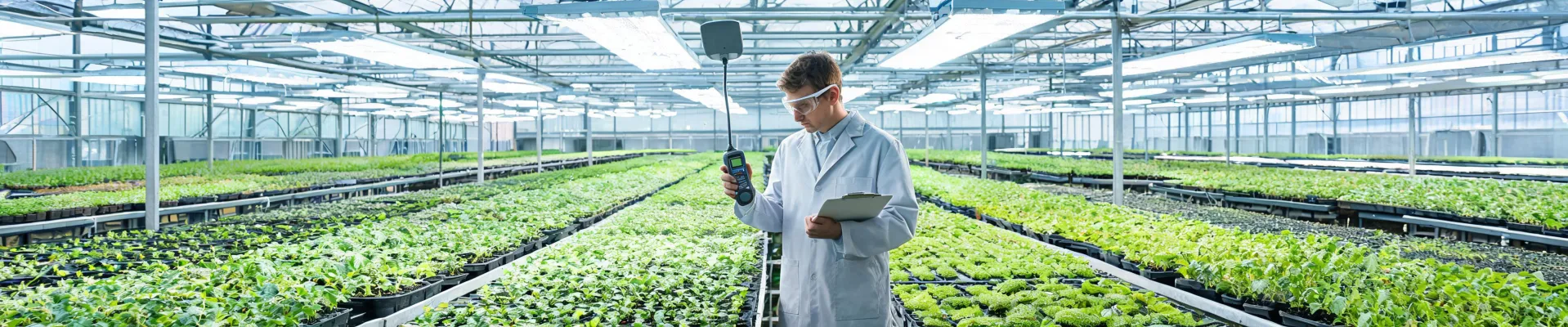
In March 2024, we evaluated two pre-production samples from a potential contract manufacturing partner. Same model number, same order, supposedly the same production line. The first fixture measured 4% above its nominal PPF. The second measured 9% below. The supplier’s datasheet tolerance was ±3%.
Individually, both fixtures would probably have worked fine for many crops. Installed together in one greenhouse bay, they’d give you uneven growth under the same light protocol. That’s the kind of inconsistency that never shows up in a sales meeting. It shows up four weeks later, when one end of the bay is clearly lagging behind the other.
We rejected the batch. But I’m grateful for the reminder: a datasheet is a starting point, not evidence.
Five things to look for in a horticultural lighting supplier
If you’re comparing suppliers for a greenhouse project, or building a product lineup as a grow light distributor, here’s where I’d focus your attention.
1. Measured spectrum data, not a marketing chart
Ask to see the spectral power distribution for each model, not just the PAR wattage. Spectrum determines how plants respond, so the curve matters more than the total photon number. A trustworthy supplier can share the SPD as a data file, along with a photometric test report from an accredited lab for the specific SKU. If a supplier can’t produce measured spectrum data, that tells you more than any brochure ever could.
2. Fixture-level efficiency, not component-level claims
There’s a difference between what an LED chip can do on a test board and what a complete luminaire delivers from the wall. Drivers, optics, thermal management—they all consume something. When somebody quotes an efficacy number, ask: “Is that measured at the luminaire level, and does it follow the definitions in ASABE S642?” If the answer is vague, that’s a red flag. A luminaire that looks efficient on paper can lose 10–15% of its performance once you add the driver, housing, and lenses.
3. A real batch-to-batch consistency policy
LEDs come from bins. Drivers change. Production lines drift. Ask how the supplier handles component changes and whether they’ll notify you before substituting parts. Ask whether published PPF values come from measuring actual production units or from design calculations. The best answer is something like “every production batch is sampled, and each SKU is verified before shipment.” The worst answer is silence, or a vague promise that “everything is tested.” That usually means nothing is tested.
4. Lifetime and warranty fine print
Longevity claims matter for total cost, but they’re easy to quote and hard to compare. Ask whether the rating is L90 or L70 at 50,000 hours, at what drive current, and at what ambient temperature. For greenhouse installations, check the IP rating: IP65 and IP66 mean different things when you’re washing down a humid greenhouse. Also read the warranty carefully. Are replacement parts covered? Labour? Freight? That’s where “cheaper” fixtures quietly become expensive.
5. Engineers who will actually talk to you
In B2B horticultural lighting, the product is only half of what you’re buying. The other half is application support. A good supplier can discuss your DLI target, mounting height, photoperiod, and crop-specific spectrum requirements without hiding behind marketing. If you’re buying OEM or private label, the conversation goes further: custom spectra, dimming protocols, packaging, catalogue support. But I’d evaluate the technical conversation before the extras. A supplier who can’t answer basic questions won’t become more helpful after you sign.
Now, about price
The lowest unit price is a tempting scoreboard, but it’s the wrong one. Suppose you save $30 per fixture on a 1,000-fixture order—that’s a real $30,000. Now suppose the delivered fixtures run 8% below the PPF you used to design your DLI. On a cloudy week in winter, that shortfall can push a crop off schedule. One delayed or uneven harvest can erase the savings several times over. I’ve watched that math play out; it isn’t a hypothetical.
I’m not saying every budget supplier delivers bad lights. There are good low-cost options and overpriced premium ones. The issue is unverified claims. When a buyer optimizes for unit price, verification tends to get dropped from the process. That’s where the real cost hides.
Instead, compare total cost per useful photon over the fixture’s expected life: purchase price, installation, energy, maintenance, and the financial impact of downtime or uneven crop response. That number is harder to calculate, but it’s the one that predicts whether a purchase was actually cheap.
When the cheaper fixture is the right call
To be fair, there are legitimate reasons to choose a lower-priced product. Maybe your crop has a modest DLI target and doesn’t need the most efficient spectrum on the market. Maybe the lights are supplemental and run only 200 hours a year, so energy savings won’t repay a premium. Maybe the installation is temporary. In those cases, a budget fixture can be the rational engineering choice—provided you asked for the same measured data and accepted the trade-off consciously.
One more thing I’ve learned: good suppliers sometimes recommend less fixture than you expected. If a representative tells you that a smaller or simpler model will already meet your DLI target, that’s a quality signal no spectrometer can measure. It means they’re solving your problem rather than maximizing your invoice.
That, honestly, is the supplier worth keeping.

Clara Whitmore is a lighting photometry and LED source analyst specializing in bulbs, tubes, strips, panels, and integrated luminaires. She interprets IES LM-79 measurements and TM-30 color rendition data through luminous flux, efficacy, intensity distribution, CCT, chromaticity, fidelity, and gamut metrics. She writes evidence-led comparisons for specifiers selecting source formats and luminaires for commercial interiors, industrial spaces, or horticultural systems where measured optical and color performance matter.